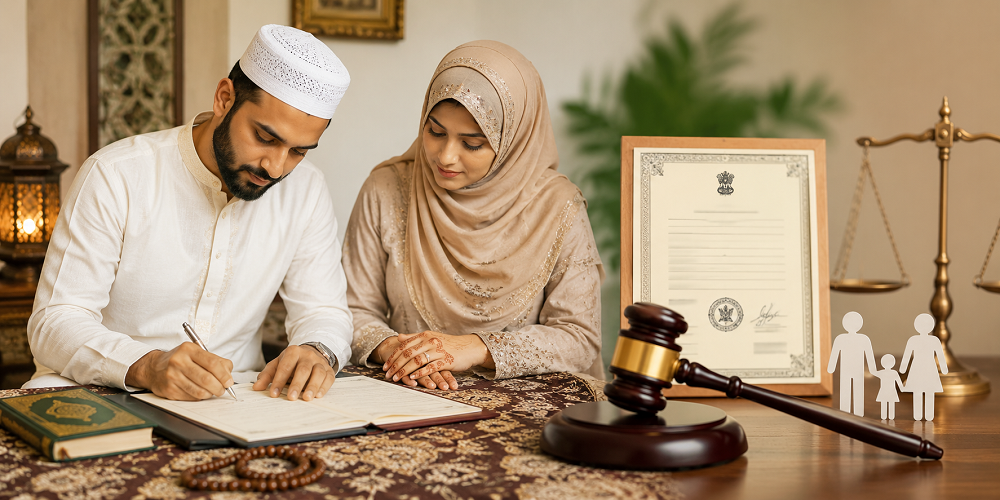
Is Your Nikahnama Enough? Why Muslim Couples Need an Official Marriage Certificate in India
A Nikah ceremony is a sacred, legally binding contractual union under Islamic law. When a couple signs their marriage contract, the religious institution or the conducting Qazi issues a traditional document known as a Nikahnama. For generations, families have treated this document as the ultimate declaration of their marital status.
However, within the modern Indian administrative and judicial systems, relying solely on a traditional religious document can lead to severe operational roadblocks. If you are preparing for international immigration, adjusting property titles, applying for a spouse passport, or opening joint financial accounts, understanding the structural differences between religious documents and a state issued registration file is absolutely critical. This official guide breaks down why a traditional contract requires a statutory government backup to stay fully compliant with Indian administrative mandates.
Nikahnama vs Marriage Certificate India: Defining the Legal Stand
To understand the core administrative requirements, couples must first differentiate between a religious contract and a statutory state registry entry. While both relate to the same marital union, their administrative weights differ fundamentally in government databases.
A dedicated process for Muslim Marriage Registration converts your customary religious contract into an universally recognized civil document, ensuring full protection of marital rights before any administrative body.
The Structural Nature of a Nikahnama
Under Muslim Personal Law in India, marriage is treated as a civil contract rather than a sacrament. The Nikahnama is the physical written record of this contract, capturing the explicit offer (Ijab), acceptance (Qubul), the presence of adult witnesses, and the mutually agreed dower amount (Mahr). While it fully establishes a valid relationship under personal laws, it does not automatically update state or central civil registries.
The Role of a Government Marriage Certificate
A government issued certificate is a secular, statutory document generated by a state appointed Marriage Registrar or Municipal Authority. It functions as the ultimate conclusive proof of a marital union under the sovereign seal of India. The administrative system treats this certificate as an independent, unassailable public record that requires no external religious verification or scriptural interpretation.
Key Operational Differences
- Issuing Authority: A Nikahnama is generated by a local Qazi, mosque trust, or religious board. A marriage certificate is generated exclusively by a Sub Registrar Office or Municipal Corporation Ward.
- Global Standardization: International embassies and visa verification software cannot process traditional Urdu, Arabic, or regional language scripts typically found on custom religious contracts. They require standard state formats.
- Database Integration: Only a government certificate registers the union in centralized data hubs, making it instantly retrievable for digital passport updates or insurance claims.
| Feature Comparison | Traditional Nikahnama Contract | Government Issued Marriage Certificate |
|---|---|---|
| Primary Issuing Entity | Local Qazi, Mosque Trust, or Islamic Board | Sub Registrar Office / Municipal Authority |
| Language Format | Often Urdu, Arabic, or Regional Dialects | English or the Official State Language |
| Sovereign Stamp | Religious Trust Seal or Personal Qazi Stamp | State Government Crest and Official Registrar Seal |
| Immigration & Visa Use | Frequently rejected by foreign consulates | Universally accepted by all global embassies |
| Digital Verification | Manual cross verification via religious trusts | Instant QR code or online portal verification |
Legal Validity of Nikahnama in India: Statutory Reality
The question of whether a traditional religious contract holds absolute legal weight has been thoroughly evaluated by Indian courts. Understanding these judicial boundaries is essential for every couple.
The Landmark Supreme Court Directive
The legal validity of nikahnama in India is valid for establishing personal rights under the Muslim Personal Law (Shariat) Application Act, 1937. However, the evidentiary presumption changes before public authorities. In the historic case of Seema v. Ashwani Kumar (2006), the Supreme Court of India ruled that all marriages, irrespective of religion, must be compulsorily registered with local government bodies.
The apex court observed that relying solely on unregistered customary documents left women highly vulnerable during matrimonial disputes, inheritance contentions, or abandonment situations. Registration does not challenge the validity of the religious rituals; it simply creates an undeniable civil record for public protection.
Essential Legal Protections
- Presumption of Marriage: A state registry entry creates a strong legal presumption of a valid marriage, placing the burden of proof on anyone who attempts to challenge the union.
- Property and Succession Rights: Under general civil laws like the Indian Succession Act or during mutation of land records, revenue officers routinely demand a government document to process survivor claims.
- Protection Against Fraud: Registration ensures that age verification, identity verification, and free consent are permanently locked into public archives, eliminating instances of identity theft or forced unions.
Crucial Benefits of Muslim Marriage Registration
Securing a government document after your traditional ceremony offers multiple structural advantages that affect your everyday civic life.
International Travel and Immigration Compliance
One of the most immediate benefits of muslim marriage registration appears during global mobility processes. Foreign embassies representing countries like the United States, United Kingdom, Canada, or Gulf Cooperation Council (GCC) nations strictly require a state issued document. They do not accept a Nikahnama for dependent visa tracking, family residency permits, or permanent residency filings.
Smooth Passport Updates and Name Alterations
The Ministry of External Affairs handles passport issuances based on verified civil status documentation. To add a spouse name to an Indian passport or to update a surname post wedding, a government issued certificate removes the need for additional complex joint affidavits or lengthy field verifications.
Banking, Insurance, and Corporate Benefits
- Nomination Processing: Life insurance providers and pension funds require a state certificate to process quick payouts to a surviving spouse without demanding extensive court kinship certificates.
- Joint Financial Portfolios: Opening joint bank accounts, applying for home loans together, or sharing corporate medical insurance benefits requires a clear civil proof of relationship.
How to Register Muslim Marriage Online India: Structural Workflow
The process to obtain an official marriage certificate after nikah involves distinct administrative phases. While initial steps can be managed via state portals, a single physical appearance is a mandatory statutory checkpoint.
Navigating the local rules of a Marriage Certificate Registration helps ensure that your document bundle contains no discrepancies when presented to the verifying officer.
Step 1: Online Profile Creation and Form Upload
Couples must access the official marriage registration portal of their respective state government (such as the e-District portal or local Municipal portal). The user must fill out the statutory application form, specifying whether the registration is being executed under local compulsory marriage rules or via Section 16 of the Special Marriage Act, 1954, for civil verification. All personal data, including the date of the Nikah and details of the Qazi, must be entered accurately before uploading scanned copies of supporting documents.
Step 2: Fee Transaction and Slot Selection
Upon completing the data fields, the user must pay the mandated government processing fee through the integrated state gateway. Once the transaction clears, the digital system unlocks an appointment calendar. The couple must select an available date and time slot for their mandatory in person verification at the local office.
Step 3: Physical Verification at the Sub Registrar Office
On the scheduled appointment day, the husband, wife, and their designated adult witnesses must physically present themselves before the Marriage Officer. The couple must carry all original physical records to match against the online uploads. The registrar verifies the signatures on the original Nikahnama and confirms that the details perfectly match the state records.
Step 4: Biometric Authentication and Record Entry
The registrar executes a biometric validation check, capturing the live digital photographs, fingerprints, and electronic signatures of the couple and their witnesses. This data is written directly into the state marriage register, eliminating any possibility of retroactive document tampering.
Step 5: Secure Digital Issuance
Once the registrar signs off on the digital file, the official marriage certificate after nikah in India is generated. The system produces a digitally signed PDF document complete with a government tracking number and a secure QR code. The couple can download this certificate directly from the state portal or collect a physical copy from the registry office.
Muslim Marriage Certificate Documents Required for Government Verification
To ensure a seamless verification session at the registrar office, you must arrange a standardized document folder. Missing records or identity mismatches can lead to immediate application rejections.
Comprehensive Checklist of Required Documents
- Original Nikahnama: The physical copy of the marriage contract issued by the Qazi, containing clear signatures of the bride, groom, witnesses, and the religious authority.
- Official Urdu Translation: If the original contract is written in Urdu, Arabic, or a regional dialect, a certified, notarized English translation must be attached.
- Proof of Age: A Birth Certificate, School Leaving Certificate, SSC Passing Board Certificate, or valid Indian Passport for both individuals.
- Proof of Residential Address: An Aadhaar Card, Voter ID Card, Electricity Bill, or a registered Rent Agreement confirming that at least one party has resided within the registrar territorial jurisdiction for over thirty days.
- Ceremony Photographs: Clear, unedited printed photographs of the active Nikah rituals, ensuring the faces of the couple, the Qazi, and the witnesses are clearly identifiable.
- Witness Documentation: Valid government issued identity cards (such as Aadhaar or PAN Cards) along with passport size photographs of at least two or three adult witnesses who signed the original Nikahnama.
- Affidavits of Marital Status: Separate notarized statements declaring the age, religion, free consent, and current marital status of both parties at the time of registration.
| Sl No | Document Classification | Specific Acceptable Options | Critical Verification Purpose |
|---|---|---|---|
| 1 | Contractual Proof | Original Nikahnama + Certified English Translation | Proves that a traditional wedding ceremony was completed |
| 2 | Statutory Age Proof | School Leaving Certificate, Passport, Birth Record | Confirms compliance with the minimum legal age rules |
| 3 | Territorial Address Proof | Aadhaar Card, Passport, Active Utility Bill | Establishes the correct local office jurisdiction |
| 4 | Witness Identification | PAN Card, Aadhaar Card, Driving License | Validates the legal identity of the individuals testifying |
Muslim Marriage Registration Process India: Crucial Timelines and Costs
Filing your paperwork within the recommended windows helps avoid unnecessary legal complications and late penalty fees.
Standard Application Timelines
Most Indian states operate under a strict timeline for compulsory marriage reporting. Ideally, the application for a government marriage certificate for muslim couples should be filed within thirty to ninety days from the date of the traditional Nikah ceremony. If a couple delays registration for months or years, the file must undergo an extended administrative review, often requiring a special condonation order from a District Magistrate or a higher municipal officer.
Statutory Fees and Emergency Processing
- Normal Filing Fees: The basic application fee set by state revenue departments is highly nominal, usually ranging between one hundred rupees to five hundred rupees, excluding standard online portal service charges.
- Tatkal Expedited Channels: For urgent international travel emergencies, several metropolitan districts offer an accelerated processing path. By paying an additional urgent fee, couples can secure their verified appointment and document download within twenty four to forty eight hours.
Top Pitfalls to Avoid During Registration
Administrative errors can stall your file for weeks. Paying close attention to formatting and data alignment is vital to a smooth process.
Common Documentation Failures
- Name Spelling Misalignments: If the husband or wife's name is spelled differently on their Aadhaar Card compared to their School Leaving Certificate or the original Nikahnama, the application will face a hard stop. All names must be completely uniform.
- Uncertified Translations: Submitting a complex handwritten Urdu Nikahnama without a legally recognized, notarized English translation is a common cause for immediate application rejection.
- Incorrect Jurisdictional Filing: Submitting your file to a ward office or registrar branch where neither the wedding took place nor either party resides will result in an immediate territorial rejection. Always check map boundaries before booking slots.
- Unavailability of Original Witnesses: If the individuals who present themselves at the registry office do not match the names or signatures listed on your original wedding contract, the registrar can halt the process for suspicious third party testimonies.
Conclusion and Strategic Legal Assistance
Securing a government document after traditional rituals is the only way to establish the legal validity of marriage in India. Managing the strict timelines and municipal documentation on your own can easily lead to unnecessary administrative delays or application rejections at the registration office.
If you want to skip the stress of complex local paperwork and endless government office queues, professional support can simplify your entire timeline. Our experienced on-ground team handles everything from initial profile verification to structural slot bookings. Connect with our experts at Marriage Registration in Pune to streamline your official documentation and secure your government marriage certificate smoothly.
Frequently Asked Questions (FAQs)
No, international consulates do not accept religious contracts or mosque trust receipts as standalone proofs of marriage. They require an official marriage certificate issued by a state government authority, complete with a digital signature or a verifiable tracking seal.
No, they are completely different. A Qazi certificate is an internal proof of a religious ceremony under personal law, while a government certificate is a statutory civil record recognized across all judicial, financial, and global corporate institutions.
If the marriage was performed as a traditional Nikah after valid conversion, it follows the personal law path. However, if both partners choose to retain their respective individual religions, the marriage must be solemnized and registered directly under the Special Marriage Act, 1954, which requires a mandatory thirty day public notice period.
You must have the document translated into English by a certified professional translator. This translated document must then be notarized by a registered public notary before you upload it to the state marriage registration portal.
Yes, the online portal is only designed for data collection, document streaming, and slot allocation. The physical presence of both spouses along with their original witnesses is a strict statutory requirement to complete biometric mapping and register signatures before the officer.